
Tamil Nadu ends Union-State relations committee
Tamil Nadu has disbanded the committee on Union-State relations headed by Justice Kurian Joseph, saying its work overlaps with the State Law Commission.
by Trends DeskNovember 19, 20263 min read
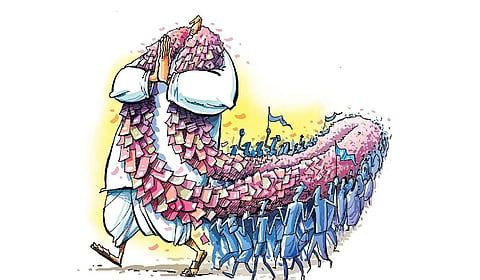
The Tamil Nadu government, headed by Chief Minister Joseph Vijay, has disbanded the high-level committee on Union-State relations headed by former Supreme Court judge Justice Kurian Joseph. The Union-State relations committee was formed in April 2025, during the tenure of former Chief Minister M.K. Stalin, to study state autonomy and the balance of power between the Union and the states.
A government order dated 6 November 2026, issued by the Public (Law and Order, F) Department, discontinued the Union-State relations committee with immediate effect. The order said the committee's work overlapped with that of the Tamil Nadu State Law Commission. The state has directed the committee's secretary and committee officer to hand over all records and papers to the Law Commission at once and report compliance to the government.
The Union-State relations committee was chaired by Justice Kurian Joseph, a former Supreme Court judge, and was asked to look at the principles of state autonomy. Its formation came as the state government was in dispute with the Union government over the National Eligibility cum Entrance Test, the sharing of GST revenue and language policy.
Why the Union-State relations committee was set up
The Tamil Nadu government formed the committee in April 2025 to examine Union-State relations and what it saw as creeping centralisation of power. The Kurian Joseph committee was asked to study how the balance between the Centre and the states had changed over the years, and to suggest ways to restore the balance the Constitution intended. Its work followed earlier exercises in Tamil Nadu, including the Rajamannar Committee of 1969, which had also examined Centre-State relations.
In February 2026, the committee submitted its report. In Part I, it recommended mandatory timelines for Governors to act on State Bills and a categorical rejection of the 'One Nation, One Language' approach. The Union-State relations committee called for a 'structural reset' to treat states as equal partners, and warned that India was becoming too top-heavy. The Kurian Joseph committee built on the work of the Sarkaria Commission of 1983 and the Punchhi Commission of 2007, which had also looked at Centre-State relations.
Why the government ended the Union-State relations committee
The government order said the committee was a non-statutory body examining issues relating to Union-State relations, and that its functions had 'a considerable similarity and overlap' with those entrusted to the Tamil Nadu State Law Commission. The order said: "Therefore, after careful consideration, the Government have decided to discontinue the services of the High-Level Committee with immediate effect."
The Tamil Nadu State Law Commission will now receive the committee's records. The order directs the secretary and committee officer of the Union-State relations committee to hand over all relevant papers to the Law Commission immediately and to tell all concerned, then report compliance to the government. No reason beyond the overlap was given in the order.
What happens to the committee's report
The committee's recommendations remain on record, including its call for timelines on Governors and its rejection of a single-language approach. The order does not say what the Law Commission will do with the report's proposals, or when it will act on them. The Union-State relations committee was the latest in a line of Tamil Nadu panels on federalism, and its end leaves the Law Commission as the state's standing body on the subject.
Related articles in Law & Government
View all Law & Government →Browse more stories in Law & Government.