Howrah dengue surge: 150 cases in a week prompt fogging
Howrah recorded more than 150 dengue cases in one week between 14 and 20 October, nearly a third of the district's total for the year so far.
by Trends DeskNovember 19, 20264 min read
Health authorities across Howrah district have launched intensive vector-control operations after a sudden surge in dengue infections, with more than 150 cases recorded within a single week between 14 and 20 October 2026. The Howrah dengue surge was reported in municipal wards and adjoining rural pockets, and it has focused scrutiny on blocked drainage networks, unattended waste and persistent post-monsoon waterlogging.
During the preceding seven months, the district had documented approximately 350 cases, so nearly a third of this year's infections emerged in this one week. The Howrah dengue surge therefore stands out against the slower spread seen earlier in the year.
Of the more than 150 cases identified between 14 and 20 October, 47 were detected within Howrah Municipal Corporation jurisdiction. Much of the remaining caseload was in peri-urban areas on Howrah's outskirts, most notably within the Bankra Number 1 gram panchayat. Local health officials confirmed at least 19 infections in residential clusters in Bankra, including Mondalpara, New Mondalpara and Uttarpara.
How the Howrah dengue surge strained local hospitals
Ninety-four patients with acute febrile illnesses and complications were admitted to Howrah District Hospital during this period. One critically ill patient was transferred to RG Kar Medical College and Hospital in nearby Kolkata for intensive supportive management. Peripheral health centres and private clinics reported steady queues of patients seeking screening for acute fever and joint pain.
Health officials note that not every admitted patient suffered from severe dengue, since admission thresholds often widen in outbreaks to cover high fevers needing intravenous hydration or observation. The Howrah dengue surge tested the district's capacity to triage fever cases quickly.
What caused the Howrah dengue surge
Howrah's Chief Medical Officer of Health, Dr Kishalay Dutta, noted that infections climbed sharply in specific peri-urban zones and civic wards where poor drainage intersected with waste accumulation. Garbage-clogged drains and water collection after late seasonal rains have created prime conditions for mosquito propagation. The Aedes aegypti mosquito breeds in small volumes of clean, non-flowing water, and it can complete its life cycle from egg to adult in as few as 7 to 10 days. The Howrah dengue surge cannot be blamed on civic infrastructure alone, since other factors also shape how fast the virus spreads once mosquitoes are present.
Common breeding sites include plastic containers, unsealed storage drums, discarded tyres, flowerpot trays, unattended birdbaths and blocked gutters and stormwater drains. Dengue dynamics also depend on mosquito density, temperature, humidity, circulating viral serotypes and herd immunity.
Dengue virus is transmitted through the bites of infective female mosquitoes, primarily Aedes aegypti and, to a lesser extent, Aedes albopictus. The Aedes aegypti mosquito typically feeds during daylight hours, showing peak biting activity in the early morning and late afternoon before dusk. The World Health Organization estimates 100 to 400 million dengue infections globally each year, and an estimated 80 per cent remain asymptomatic or mild.
Dengue vector control measures under way in Howrah
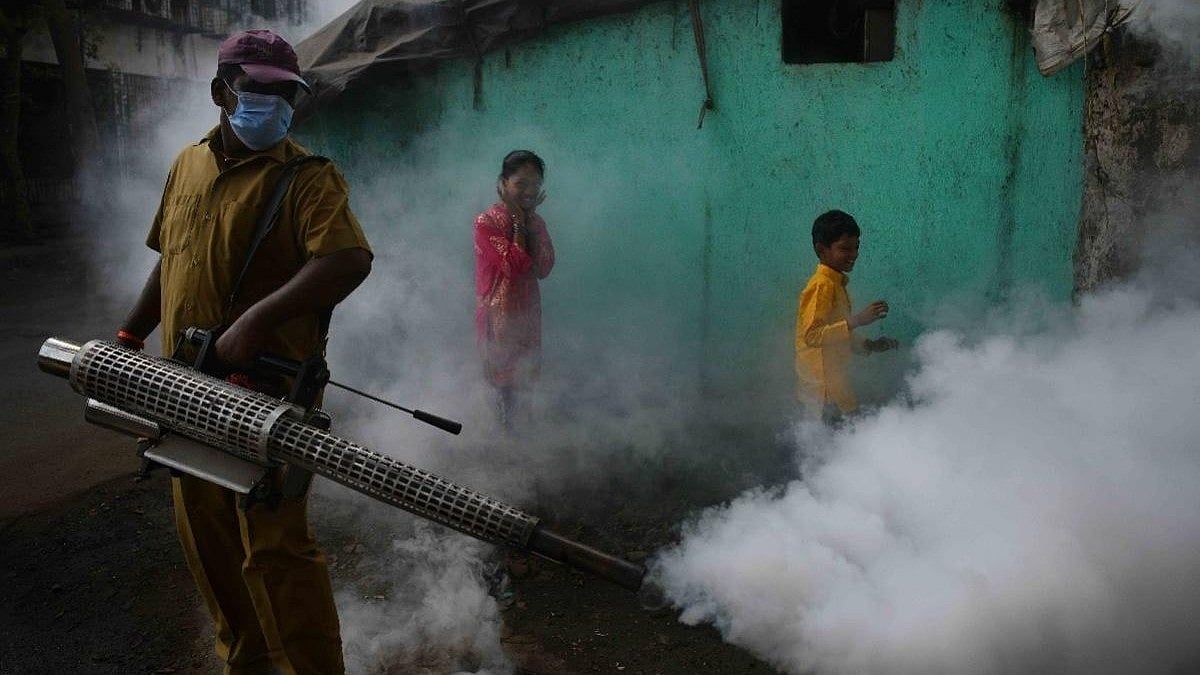
In response, a multi-tier containment effort was mobilised, uniting sanitation workers, panchayat field teams and district vector-control personnel. Response teams began routine larvicidal and adulticidal fogging across heavily populated lanes, clearing of clogged drainage channels and silt, and door-to-door inspections to eliminate domestic and peri-domestic standing water. The Howrah Municipal Corporation count of 47 cases covers the city wards, while the rest came from peri-urban pockets, and the response covers both. Dengue vector control during the Howrah dengue surge works on two fronts at once: killing adult mosquitoes and removing the water where larvae grow.
Public health guidance stresses that fogging cannot replace source reduction, since mosquito eggs can survive for months on dry surfaces and hatch once submerged. During the Howrah dengue surge, households are urged to empty, scrub and invert water storage containers weekly, fit mesh screens, use treated bed nets, wear loose, long-sleeved, light-coloured clothing and use registered repellents during peak biting hours.
There is currently no specific antiviral therapy approved to treat or cure dengue infection, and care relies on supportive therapy, fluid management and early recognition of vascular leakage or haemorrhage. When managed early with standard World Health Organization fluid replacement, mortality from severe dengue falls below 1 per cent. Health authorities also warn against ibuprofen, naproxen, diclofenac and aspirin during suspected dengue, since they disrupt platelet function, and paracetamol under medical supervision is the approved option for fever. India's National Centre for Vector Borne Diseases Control compiles national surveillance data, and Howrah's figures will feed into wider state bulletins as the Howrah dengue surge response continues.