September Jobs Report: 29,000 Jobs Added, Misses Forecasts
The September jobs report disappointed: employers added just 29,000 payrolls in September 2026 while unemployment rose to 4.2%, well below forecasts.
by Trends DeskOctober 19, 20262 min read
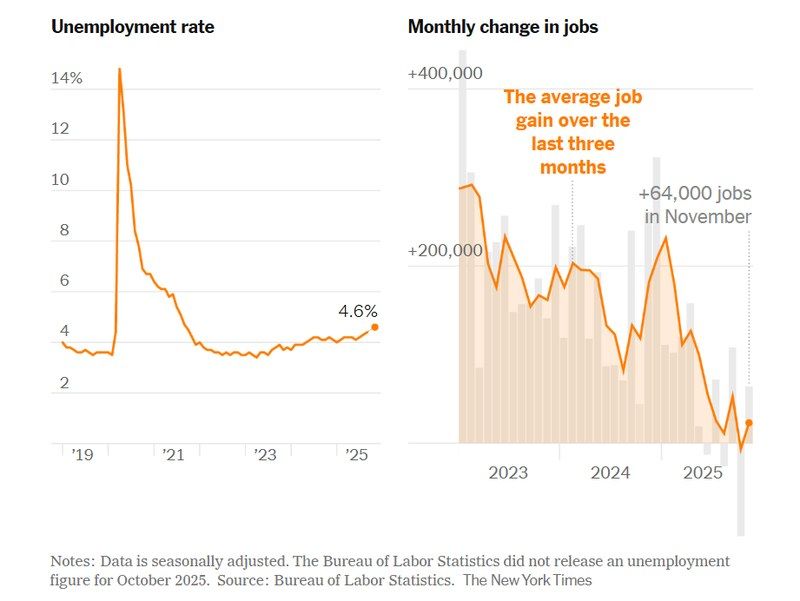
The September jobs report disappointed both Wall Street and Washington. The Bureau of Labor Statistics said on Oct. 2 that nonfarm payrolls rose by only 29,000 in September 2026, far short of forecasts of 84,000 to 90,000. Unemployment rose to 4.2 percent from 4.1 percent in August, with roughly 7.1 million people out of work. The labor market is cooling faster than most forecasters expected, though the jobless rate is still inside the 4.1-to-4.3 percent range it has held since March 2026.
Revisions made it worse. The BLS revised August growth to 133,000 while cutting a combined 60,000 jobs from July and August. Over the past 12 months, payrolls grew by only about 45,000 a month on average.
That average barely keeps up with population growth, so the economy is no longer adding the extra jobs that used to push unemployment down. With growth this close to breakeven, small changes, such as a few thousand fewer hires in one industry or a slight rise in people leaving jobs, can move the headline numbers.
Expectations were already low. The 84,000 to 90,000 forecast was modest by historical standards, and the actual 29,000 was barely a third of the low end. It was one of the weakest months for hiring in 2026.
Where the jobs came from
Gains came from only a few industries. Health care added roughly 17,000 jobs, continuing its long run as the most reliable source of new work. Construction added about 11,000 and manufacturing roughly 9,000. Financial activities lost about 7,000. Most other major industries barely changed, a pattern seen through much of 2026 as businesses hold off on hiring.
In a healthy economy hiring is spread across many sectors. In September almost all of it came from three, while finance shrank and everything else stood still. That helps explain why unemployment rose without a wave of layoffs.
More people looking for work
Labor force participation rose to 61.8 percent. More Americans are entering or returning to the workforce, which suggests they think jobs are out there. But with payrolls growing so slowly, the new entrants aren't being hired quickly, and that pushed unemployment up to 4.2 percent.
Economists will look to the October figures. If hiring bounces back, September may turn out to be a blip. If it stays weak, the labor market has shifted into a much slower gear. Either way, the trend this year is clear: job growth is fading, some openings are harder to fill while others are disappearing, and workers face a tougher market than two years ago.
For policymakers the picture is mixed. Weak payrolls argue for caution, while solid participation is reassuring about the supply of workers. Markets will study every coming release, from weekly jobless claims to the next employment report, to see whether September was an outlier or the new normal.