India car exports H1 FY27: Maruti holds over half
Car exports from India reached 4,51,479 units in April to September 2026, up 1.25%. Maruti alone added 24,813 units and took a 51.07% share.
by Trends DeskOctober 26, 20264 min read
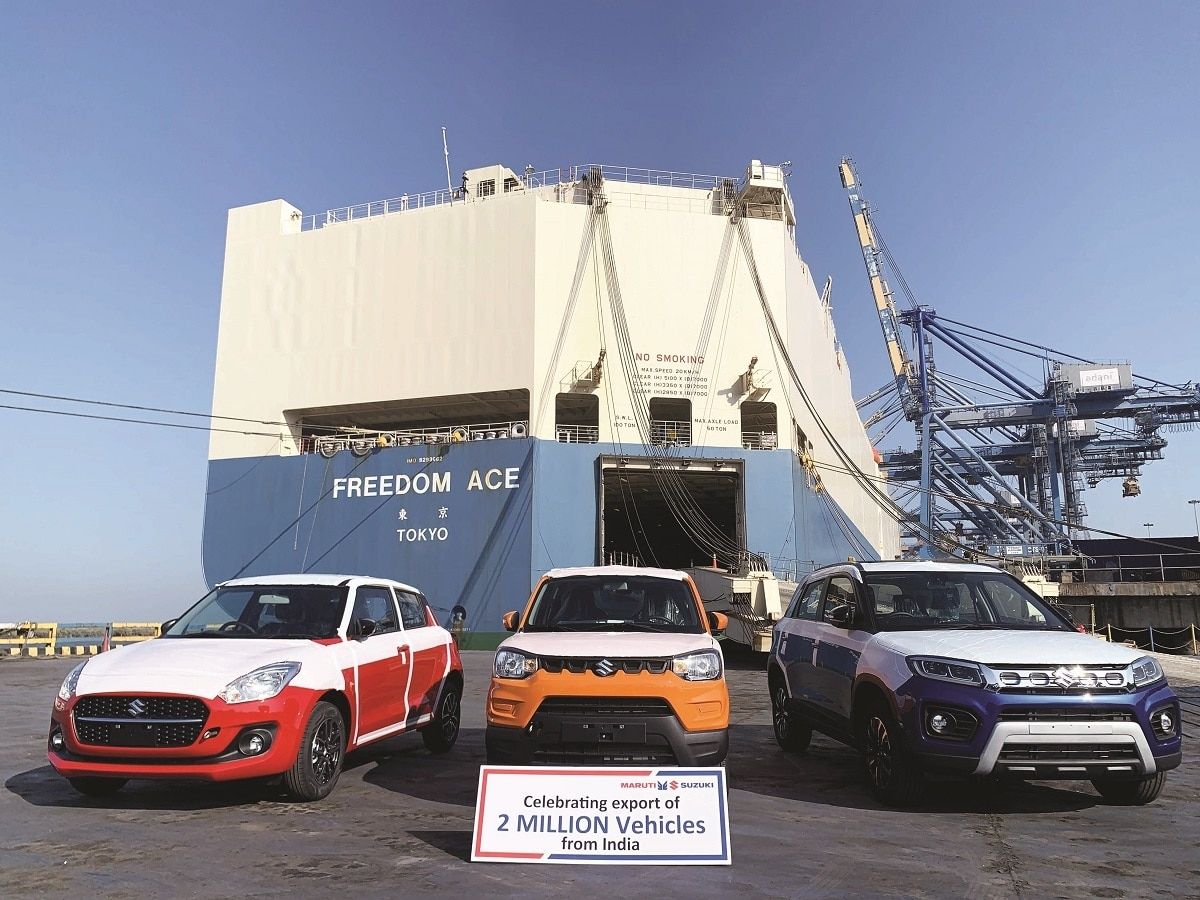
Car exports from India reached 4,51,479 units in April to September 2026, up only 1.25% from 4,45,884 units in the same period last year, according to model-wise data published by RushLane on 25 October 2026. India car exports H1 FY27 added just 5,595 units year on year, even as domestic sales grew 27.16% in the same period. The contrast between the two markets is the main feature of the half-year export data, since exports made up only 14.62% of the combined domestic and export volume of 30,88,405 units.
India car exports H1 FY27: Maruti drives growth
In India car exports H1 FY27, Maruti Suzuki exports reached 2,30,576 units, up 12.06% from 2,05,763 units a year earlier, an increase of 24,813 units. That increase alone was larger than the whole industry's net gain of 5,595 units, which means the rest of the industry, taken together, shipped fewer cars than a year earlier. Maruti Suzuki exports took a 51.07% share of the total, up from 46.15%, a gain of 4.92 percentage points. At model level, the Fronx led the export rankings, with the Jimny close behind, and the two models together contributed more than one fifth of India's total car exports.
Hyundai car exports ranked second with 92,008 units, down 7.57% from 99,540 units, for a 20.38% share. Nissan ranked third with 30,014 units, down 20.19% from 37,605 units. Volkswagen recorded 20,201 units, down 27.88% from 28,011 units, and Toyota completed the top five with 16,679 units, down 11.66% from 18,880 units. Together, Maruti and Hyundai accounted for more than 71% of car exports from India, so the export market is now heavily concentrated in two makers.
India car exports H1 FY27: gainers and losers
India car exports H1 FY27 gainers included Kia, which grew its exports 12.94% to 15,434 units, Honda grew 6.01% to 14,039 units, and Renault grew 69.52% to 11,526 units, helped by the Triber more than doubling to 3,951 units. Tata grew 42.62% to 7,543 units, with the Tiago up 140.01% to 4,721 units, and Skoda grew 85.59% to 1,481 units. Mahindra went the other way, with exports down 32.19% to 7,366 units, while Jeep fell 54.82% to 741 units and Citroen stayed almost flat at 3,782 units. Hyundai car exports fell 7.57% while Kia and Renault grew. Newer export models included the Maruti Victoris at 10,710 units, against just five units a year earlier, the Nissan Tekton at 1,637 units, and the Renault Duster at 1,467 units.
The India car exports H1 FY27 top 50 models together accounted for 4,49,787 units, or 99.63% of reported exports, and their combined volume grew 2.45%, faster than the overall market. The Ertiga grew 57.18% to 15,118 units, the Hyundai Venue grew 74.40% to 7,063 units, and the Tata Tiago grew sharply from a smaller base. The model data show that a small set of India-built cars, led by the Fronx and Jimny, carries most of the export volume, while many other models ship in small numbers.
India car exports H1 FY27: why exports lagged
No carmaker has given a reason for the India car exports H1 FY27 gap between domestic growth of 27.16% and export growth of 1.25%, according to the reporting on the data. One possible factor, noted in that reporting, is factory capacity: when the home market is this strong, factories have less spare capacity for overseas orders. The Brezza, for example, does not appear in the top 50 export list at all, even as it keeps selling strongly in India. Mahindra is another case where exports fell while domestic sales stayed busy, which fits the same capacity explanation, though the data alone do not prove it.
For buyers and for the industry, the India car exports H1 FY27 figures show a market where one maker now ships more cars abroad than all other makers combined in share terms, since Maruti passed the halfway mark. Whether that share holds will depend on whether other makers rebuild export volumes in the second half, and on whether domestic demand eases enough to free factory capacity for overseas orders.