India Employability Crisis: Degrees Without Jobs
India employability crisis examined by Outlook: outdated degrees, weak practical training and a curriculum-industry gap leave graduates unprepared for jobs.
by Trends DeskOctober 22, 20264 min read
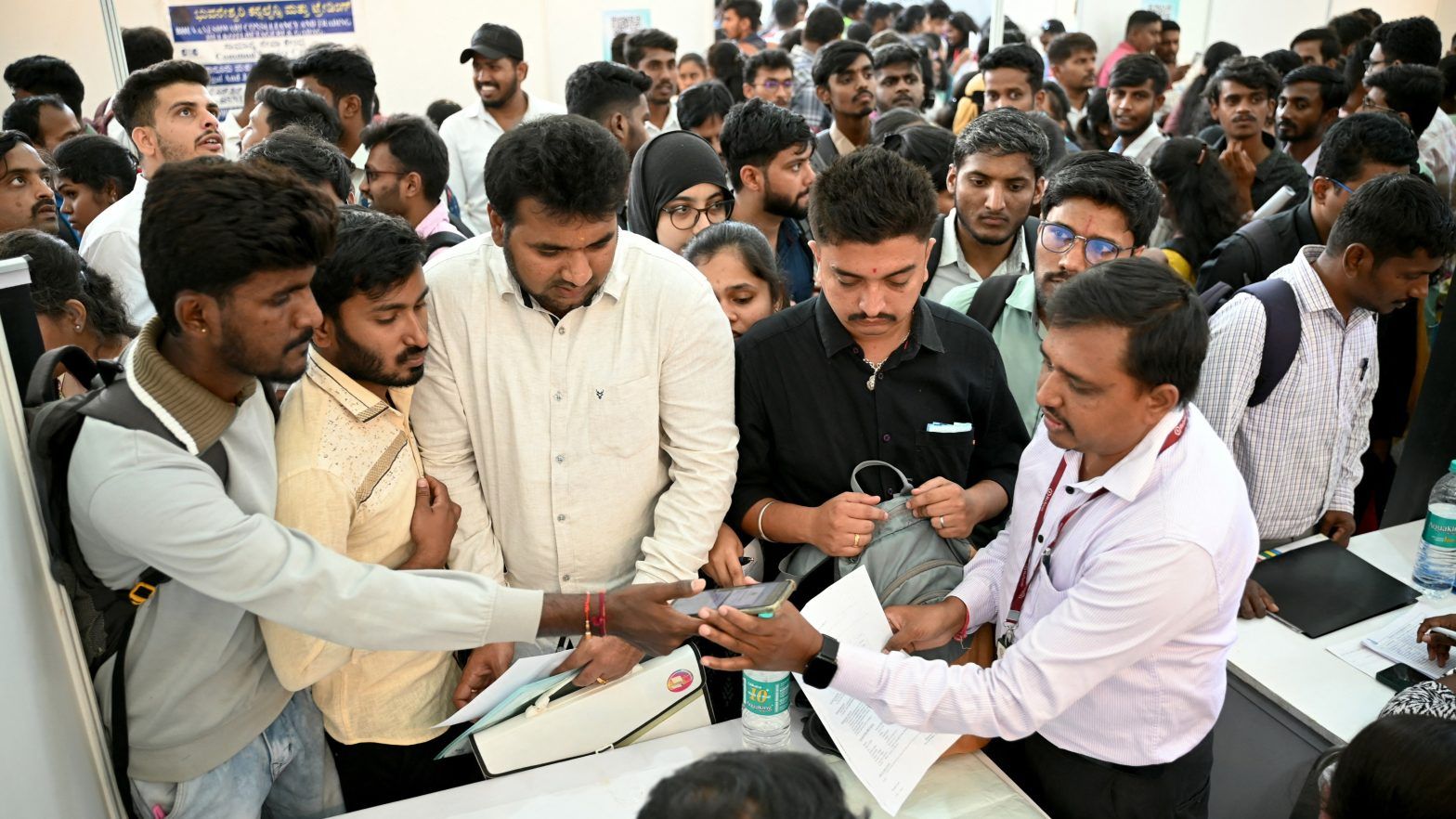
India produced 1.09 crore graduates across all disciplines in 2022-23, yet employers keep saying they cannot find people with the right skills. Outlook India's cover story this week calls it what it is: the India employability crisis. Degrees offer academic credentials but do not always translate into employment, and the disconnect between what universities teach, what employers need and what young people expect from higher education keeps widening. The India employability crisis is no longer a warning about the future; it is the present tense of the country's graduate workforce.
India employability crisis by the numbers
The figures are stark. A NITI Aayog skilling paper, "Reimagining Skilling for Viksit Bharat @2047," published in August, says only 8.25% of graduates are employed in roles aligned with their qualifications, citing the Economic Survey 2024-25. The paper describes a "fundamental disconnect" at the heart of the India employability crisis: what is taught in classrooms and what the labour market demands, with outdated curricula producing degrees that do not consistently convert into employability.
The India Skills Report 2025 puts overall graduate employability between 42 and 55%: management graduates show 78% employability, engineering 71.5%, MCA 71% and science graduates 58%, while arts and general B.Com holders often fall below 40%. On the ground, the picture is worse: 83% of engineering graduates leave college without a single job offer or internship, and 46% of MBA graduates face the same shortfall. Nearly half of all graduates are not immediately job-ready, which is the graduate employability problem in one line.
Why the India employability crisis persists
Former Union human resource development minister Prakash Javadekar told Outlook that the National Education Policy 2020 itself observed the system is theory-heavy: a mismatch between curriculum and industry needs, limited practical exposure, faculty and infrastructure constraints, and weak communication and soft skills. Four structural reasons explain the India employability crisis, analysts say: outdated degrees built on syllabi that lag behind technologies such as AI, data analytics and cloud computing; limited practical exposure through internships and live projects; neglect of soft skills such as communication, teamwork and adaptability; and a persistent disconnect between academic curricula and industry expectations.
Bindhy Wasini Pandey, director of the Centre for Himalayan Studies at Delhi University, learnt how deep the problem runs when he was invited as an examiner. All 40 students from a college in Haryana had collected data for geographical mapping from a single village; only one person wrote a handwritten report while the others simply got it photocopied. Costly B.Tech and MBA degrees offer no immunity either. Arijit Bose, managing partner of Arc Talent Solutions, told Outlook that graduates from sub-standard tech and management colleges often lack skills, technical knowledge and familiarity with their industry's issues, leaving them unemployable.
Fixing the India employability crisis
To fix the India employability crisis, the NITI Aayog skilling report recommends industry-led skilling through structured public-private partnership models: modernising the outdated degrees and curricula behind them, embedding job-linked learning directly into syllabi and securing broader private sector engagement so that skilling stays connected to real employment outcomes. Future reforms, it says, will focus on specialised, job-linked programmes targeted at high-growth sectors, including green industries and electric vehicle manufacturing, with modular, part-time, hybrid and earn-while-you-learn structures.
There are bright spots. Nearly 46% of Indian graduates are now considered job-ready for AI and machine-learning roles, a sharp rise in recent years, suggesting that where the right skills are taught, outcomes improve. A degree may open the door; skill determines whether a graduate walks through it. For the India employability crisis, the fix is less about producing more graduates and more about making sure the years spent earning the degree count for something in the workplace.
What employers say they need
Recruiters describe the India employability crisis from the other side of the table. A recruiter at a mid-sized manufacturing firm in Pune once interviewed a final-year engineering student with a 9.2 CGPA who could give a technically correct account of a project but could not explain it in plain language or write a short professional email. He had never been required to communicate, collaborate or apply knowledge in a real-world setting. The recruiter's conclusion was simple: industry needs people who can build things and talk about what they built.