Navratri auto sales up 26.76% as EV share hits 10.5%
FADA provisional data puts Navratri 2026 retails at 11.23 lakh units, up 26.76%, as EV retails grew 26.78% to a 10.5% share of festive sales.
by Trends DeskOctober 23, 20263 min read
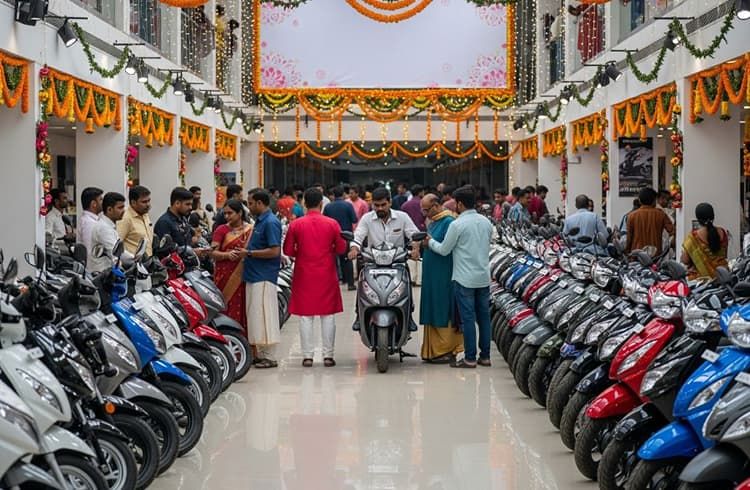
Navratri auto sales made this year's festival one of the strongest buying periods dealers have seen in recent memory. Showrooms retailed 11,23,086 vehicles between October 11 and October 20, up 26.76% over the same Navratri period in 2024, according to provisional data from the Federation of Automobile Dealers Associations (FADA). Electric vehicles kept pace with the wider market. EV sales grew 26.78% to 1,17,437 units, taking the EV share of festive auto retail to about 10.5%, up from roughly 7.7% a year earlier.
How Navratri auto sales were split across segments
Electric two-wheelers did most of the heavy lifting inside the EV sales numbers. Dealers sold 75,758 electric two-wheelers in the ten-day window, a jump of 33.41% over last year. Electric passenger vehicles came next with 12,305 units, up 25.97%, followed by electric three-wheelers at 28,086 units, a gain of 10.51%. The sharpest percentage growth came from the smallest base: electric commercial vehicles rose 96.04% to 1,288 units. Across all four segments, the Navratri auto sales data shows electric options gaining ground.
For dealers, the Navratri auto sales mix matters because two-wheelers move in volume even at lower ticket sizes. Two-wheelers remain the entry point for electric mobility in India, and their volumes dwarf every other electric segment put together. Passenger vehicles are growing steadily, though from a smaller base. Commercial vehicles are still tiny in absolute terms, but the near doubling suggests fleet operators are starting to buy electric in small numbers.
Why Navratri auto sales trail last year's mark
The headline growth comes with a caveat. Overall retails for this year's festival fell 6.52% compared with Navratri 2025. FADA president Sai Giridhar said the comparison is uneven: last year's Navratri ran for eleven days instead of ten, and it fell inside the GST 2.0 demand window, when buyers hurried purchases ahead of the tax change. None of that changes the two-year trend, but it explains why Navratri auto sales look softer than 2025 on a straight read.
Measured against Navratri 2024, however, the picture is cleaner. Volumes are up more than a quarter, and the festive season did what dealers expect of it: it pulled forward purchases that buyers might otherwise spread across the quarter. The 2025 dip looks like an effect of the calendar and the tax calendar rather than a sign of weak auto retail demand.
What Navratri auto sales say about electric mobility
The EV share crossing 10% is the number manufacturers and dealers will study most closely. A year ago, electric vehicles made up about 7.7% of Navratri retails. Moving into double digits during this year's festive season puts electric options inside the mainstream choice set for festive buyers, especially in two-wheelers and three-wheelers, where lower running costs favour electric models. EV sales are now roughly one in ten festive retails, and the Navratri auto sales data shows the shift is broad rather than confined to one segment.
There are limits to what the numbers show. FADA's figures are provisional and cover only the October 11 to 20 window, and the association has not released a petrol and diesel split for the festival period. Even so, the available data gives the industry its second-strongest festival for auto retail in two years, and gives electric vehicles their largest share of a festive season so far.