New Noida: 5 Facts Behind the 20,000-Hectare Land Plan
New Noida will add 20,000 hectares of developable land in Uttar Pradesh, targeting 5-6 lakh jobs by 2030. What the phased master plan means for investors.
by Trends DeskOctober 17, 20263 min read
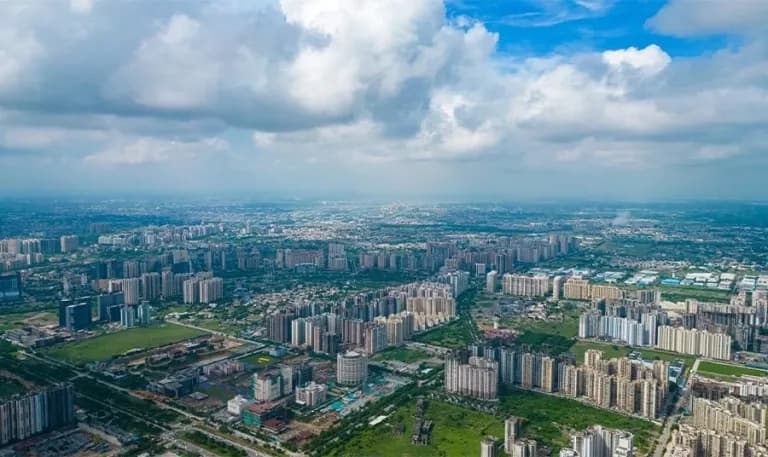
The Uttar Pradesh government is planning to develop New Noida across approximately 20,000 hectares to accommodate rising industrial demand, one of the largest planned urban expansions announced in the National Capital Region this decade. According to an October 14 update on the official Invest UP website, Noida Authority chief executive Krishan Karunesh has said the proposed New Noida expansion aims to generate five to six lakh direct and indirect jobs by 2030, with land acquisition expected to proceed in phases. The announcement matters because Noida has effectively run out of room. Since its establishment as an industrial city in 1976, Noida has grown into a major industrial, technology and commercial hub, but about 90 per cent of its area has already been developed. With limited scope for further expansion inside existing boundaries, the authority is looking outward for the next chapter of Noida real estate growth. ## New Noida tackles the region's land shortage The main aim of the New Noida land plan is to address this shortage. Rising demand for industrial plots and business space has put sustained pressure on land availability, and the proposed project is intended to accommodate new industrial activity and provide space for future investment across the region. The project sits within the Dadri-Noida-Ghaziabad Investment Region, planned across parts of Gautam Buddha Nagar and neighbouring Bulandshahr district. The Noida Authority approved the draft Master Plan 2041 in 2023, which envisaged the acquisition of about 21,000 hectares, and the current proposal to develop nearly 20,000 hectares across 168 sectors is the execution phase of that blueprint. ## How the New Noida build-out will be phased Development will unfold in four phases. The first phase covers 3,165 hectares and is scheduled for completion by 2027, followed by 3,798 hectares between 2027 and 2032, 5,908 hectares by 2037 and 8,230 hectares by 2041. About 40 per cent of the total land is earmarked for industrial use, reflecting a deliberate bet on manufacturing-led growth alongside residential expansion. The industrial push is already visible. Reports indicate that around 120 projects involving investments of nearly Rs 35,000 crore are expected to move forward at the upcoming fifth ground-breaking ceremony, covering data centres, electronics manufacturing, commercial development, logistics and institutional projects. For the Noida real estate sector, that pipeline could create demand for industrial plots, warehouses, logistics parks, office space and supporting commercial infrastructure. Connectivity is the other pillar of the New Noida land plan. The authority is examining three proposed metro corridors that would link the future urban area with the Bodaki multimodal transport hub, Botanical Garden and Gaur City via Char Murti, strengthening the movement of goods and workers across the wider NCR. ## What the New Noida plan means for buyers and investors For homebuyers eyeing New Noida, the location of employment centres, access to public transport, civic amenities and the actual delivery of infrastructure will be the decisive factors. For investors, the consistent advice is to distinguish between approved development plans, proposed infrastructure and projects that have actually been completed. Separately, the Uttar Pradesh government is considering policy options to permit additional floor area ratio in existing Noida, which could allow more construction on eligible plots subject to planning regulations, though that proposal remains under consideration. The coming years will determine whether the New Noida expansion delivers the employment, connectivity and real estate opportunities now being promised. For now, the vision is a plan with a timetable, not a finished city, and its success will depend on land acquisition, infrastructure delivery and the industries that choose to set up there.
Related articles in Real Estate
View all Real Estate →Browse more stories in Real Estate.


