RSS route march: Madras High Court clears 128 venues in TN
The Madras High Court has cleared the RSS route march at 128 Tamil Nadu venues on October 25 and November 1, rejecting the police's 'lame' reasons.
by Trends DeskOctober 17, 20264 min read
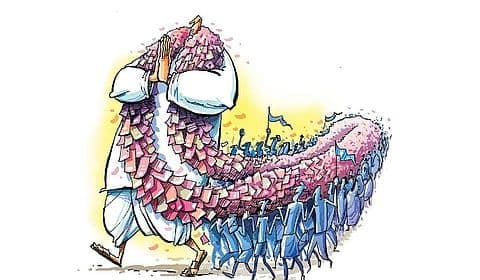
Chennai, Oct 17 — The Madras High Court on Friday permitted the Rashtriya Swayamsevak Sangh (RSS) to conduct route marches at 128 locations across Tamil Nadu on October 25 and November 1, pulling up the Tamil Nadu police for repeatedly rejecting applications on grounds the courts had already found wanting. The latest RSS route march order, dictated in open court by Justice V Lakshminarayanan, directs the police to finalise timings, routes and venues by Monday, October 19. The petition was filed by the RSS state secretary, who had applied to the Director General of Police on October 3 seeking permission for marches between 3 pm and 7 pm, followed by public meetings, as part of the organisation's annual Vijayadashami march. Volunteers in uniform, led by a music band, were to take part. The RSS route march will be accompanied by public meetings at each of the proposed venues. Police had rejected the applications, citing restricted routes, places of worship of other communities, a rationalist leader's statue, traffic congestion, unstated participant numbers, loudspeakers and law and order concerns. ## RSS route march cleared for October 25 and November 1 During Friday's hearing, Advocate General Vijay Narayan informed the court that the state was agreeable to permitting the processions on October 25 and November 1, subject to modifications that local police authorities might suggest depending on prevailing conditions. The court recorded the submission and froze the two dates, directing the Tamil Nadu police to settle the logistical arrangements for the proposed RSS route march by October 19. The RSS also furnished details of the proposed processions, including routes, organisers, participant numbers and venues. The court directed that these be annexed to its order to prevent disputes, and recorded the RSS's undertaking to comply with conditions from earlier proceedings. ## Court rejects 'lame' reasons for refusal The sharpest remarks in the RSS route march case were reserved for the police's stated grounds for rejection. "They have not come up with any novel reasons for rejection. They have consistently given the very reasons which this Court found as lame," the court observed, noting that the same objections had been considered and disapproved in earlier proceedings. At an earlier hearing on Wednesday, the judge had questioned the state's stance more broadly, asking why the RSS route march was being denied permission in Tamil Nadu when it was permitted to hold marches even in Jammu and Kashmir. "What is your fear? Every year they are coming for permission and the Court is granting. What is so exceptional in 2026?" the judge asked, and sought to know whether any violence had occurred during earlier marches. Senior advocate N L Rajah, for the petitioner, argued that guidelines were not inflexible rules and police should have sought clarifications instead of rejecting applications outright. He also objected to references in the police orders to mosques along the proposed routes, arguing that such reasoning weakened communal harmony. ## RSS route march: a four-year legal battle The court traced the long history of the dispute over the RSS route march. Conditions for the marches were first laid down in September 2022; a Division Bench restored that order after it was modified in review, and the Supreme Court dismissed the state's appeal on April 11, 2023. In October 2023, the court allowed another batch of petitions, holding that public roads are secular spaces belonging to everyone regardless of religion, caste or creed. The judge noted that detailed guidelines had been framed to ensure such litigation would not repeatedly consume the court's time — guidelines whose purpose, Justice V Lakshminarayanan said, had been breached by both sides' failure to cooperate. "It was expected that the parties will cooperate with each other. This faith has been entirely misplaced," the court observed, describing the case as litigation that should never have arisen. ## What happens next With the dates frozen, the Tamil Nadu police must now settle routes, timings and venues for each RSS route march by October 19, and the state has assured the court that the applications will be considered with any necessary changes based on local circumstances. The court also advised RSS organisers to apply well ahead of planned events in future, noting that the Vijayadashami march period was known in advance. The right to march has thus been upheld once again by the Madras High Court — but the annual courtroom battle over the RSS route march shows little sign of ending.
Related articles in Law & Government
View all Law & Government →Browse more stories in Law & Government.


